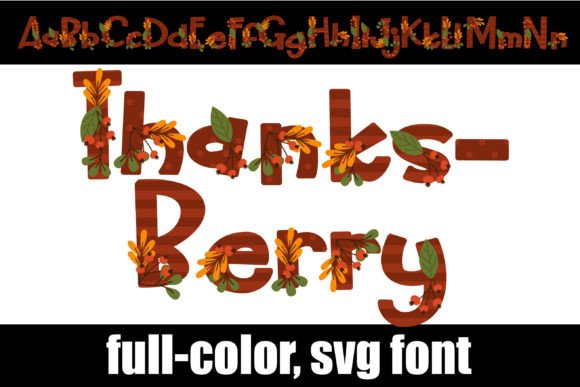
Thanksberry: A Whimsical Font for Festive Branding
There’s a certain magic in the air when autumn arrives—the crispness, the colors, and the anticipation of gathering with loved ones. For designers and creators, this season offers a rich palette of inspiration, especially when it comes to typography. Imagine capturing that cozy, celebratory spirit in a single typeface. That’s exactly what Thanksberry delivers: a whimsical sans serif font adorned with delicate Thanksgiving berries and leaves, designed to infuse your projects with seasonal charm and visual warmth.
Thanksberry isn’t just another decorative font. It’s a thoughtfully crafted design asset that balances playful detail with practical usability. Each letterform features subtle botanical accents—think tiny berries nestled into curves and leaf motifs along stems—without sacrificing legibility. What sets it apart is the included alt case: a cleaner version of each letter without the botanical elements. This dual-style approach gives you incredible flexibility. Use the ornate version for headlines and display text where you want maximum impact, then switch to the alternate for body copy or smaller applications where clarity is key.
Bringing Seasonal Warmth to Your Visual Identity
For businesses and brands that thrive on autumnal themes—think bakeries, farms, craft stores, event planners, or even cozy lifestyle blogs—Thanksberry offers a distinctive voice. Its whimsical character makes it ideal for logos, product packaging, and social media graphics where you want to evoke a sense of harvest, gratitude, and handmade quality. Picture it on a farmers market sign, a Thanksgiving menu, or the header of a seasonal email campaign. The font’s organic details feel authentic and approachable, helping to build an emotional connection with your audience.
Beyond seasonal projects, Thanksberry can add a touch of rustic elegance to year-round branding for businesses that emphasize natural ingredients, artisanal craftsmanship, or family traditions. Its versatility shines when paired with complementary typefaces. For instance, coupling Thanksberry with a simple sans serif like Montserrat or a classic serif like Lora creates a balanced hierarchy that keeps designs professional while letting the display font’s personality stand out. This kind of thoughtful font pairing is essential for maintaining visual consistency across different platforms—from your website to printed materials—ensuring your brand looks cohesive and intentional.
Practical Applications Across Creative Projects
The true test of any premium font is how well it performs in real-world scenarios. Thanksberry excels in a variety of applications, thanks to its blend of decorative flair and functional design. In packaging design, the botanical details can enhance labels for jams, sauces, candles, or artisanal goods, instantly communicating a product’s handmade or organic nature. For editorial layouts, use it for chapter titles, pull quotes, or magazine headings to add visual interest without overwhelming the page.
Digital creators will find it particularly useful for social media graphics, blog headers, and website banners. Its eye-catching style can increase engagement by making posts feel more festive and shareable. Meanwhile, entrepreneurs can leverage it for marketing assets like flyers, posters, and invitations, where the font’s celebratory vibe helps set the tone for events or promotions. Remember, though, that Thanksberry is an OpenType-SVG color font. This means it’s compatible with specific software like Adobe Photoshop, Illustrator, Silhouette Studio, and Inkscape. It’s not suitable for all cutting machines or basic text editors, so always check compatibility with your tools before purchasing. For those using compatible platforms, the results are vibrant and dynamic.
Ensuring Readability and Professional Polish
While decorative fonts are fantastic for grabbing attention, they must be used judiciously to maintain readability. Thanksberry’s design thoughtfully addresses this by providing that clean alt case. A good rule of thumb is to reserve the full decorative version for larger text sizes—typically 18 points or above—where the berry and leaf details can be appreciated without becoming muddy. For smaller text, subheadings, or longer passages, switch to the alternate style to ensure your message is communicated clearly.
Always test your designs in context. View your graphics at the actual size they’ll be displayed, whether on a mobile screen or a printed poster. This step is crucial for spotting any potential legibility issues early on. Furthermore, consider the commercial licensing that accompanies the font. If you’re creating assets for a client or for products you intend to sell, ensure the license covers your intended use. Understanding these details upfront prevents headaches later and is a mark of a professional creative process.
A Thoughtful Addition to Your Design Toolkit
Choosing the right typeface is about more than just aesthetics; it’s about finding a tool that aligns with your project’s goals and enhances your workflow. Thanksberry fills a specific niche beautifully. It’s not a workhorse font for body text, but rather a specialized display typeface that adds character and seasonal flair. Its value lies in its ability to instantly convey a theme—gratitude, harvest, autumn celebration—through its visual language.
For the designer, it’s a creative asset that can spark new ideas. For the small business owner, it’s a way to stand out in a crowded market with unique branding. For the crafter or hobbyist, it’s a fun element to elevate personal projects. By integrating Thanksberry thoughtfully—pairing it with simpler fonts, using its alternate styles strategically, and applying it to the right projects—you can create designs that feel both professional and full of personality. It’s a reminder that good design often lies in the details, and sometimes, those details are as delightful as a cluster of berries on a vine.