Bunny Doodle: The Color Font That Brings Easter Projects to Life
Imagine you're designing Easter invitations for a community egg hunt. You've got adorable bunny illustrations, pastel backgrounds, and cheerful wording—but something feels flat. The typography looks generic, like it belongs on a tax form rather than a festive celebration. That's exactly the moment when a font like Bunny Doodle can transform your entire design from forgettable to genuinely delightful.
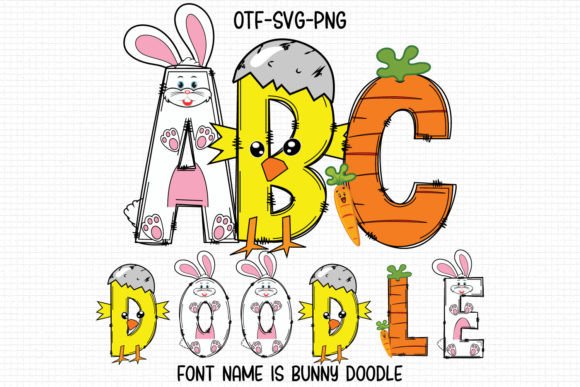
Bunny Doodle is a color font with personality. It's sweet without being childish, chic without feeling cold, and bubbly without crossing into cartoon territory. The letterforms carry a hand-drawn quality that feels warm and approachable, while the built-in color palette gives each character an illustrated charm that standard fonts simply can't replicate. If you've ever struggled to find typography that matches the playful energy of spring-themed projects, this typeface solves that problem in a surprisingly elegant way.
What Makes a Color Font Different
Most fonts you encounter daily are monochrome—they render in a single color that you choose in your design software. Color fonts, sometimes called chromatic fonts, carry their own embedded colors, gradients, textures, or even illustrations within each glyph. Bunny Doodle falls into this category, offering letterforms that arrive with built-in visual detail.
This matters more than you might think. When a font already includes color and texture, you skip the extra steps of adding effects, layering, or manually coloring individual letters. The result is a more cohesive look with less effort. For busy small business owners juggling product launches and social media calendars, that kind of efficiency is genuinely valuable.
The visual style of Bunny Doodle leans into hand-drawn aesthetics with soft edges and a slightly irregular baseline—the kind of imperfection that makes designs feel human and inviting rather than sterile. It reads well at medium to large sizes, which makes it ideal for headlines, logos, and display text where personality matters more than dense paragraph readability.
Practical Applications Across Projects
One of the strongest aspects of Bunny Doodle is its versatility across different project types. Here's where it tends to shine:
- Packaging design for seasonal products like spring candles, bath bombs, chocolates, or artisan goods. The font's warmth pairs beautifully with kraft paper textures and pastel product photography.
- Social media graphics for Instagram posts, Pinterest pins, or Facebook event covers. Color fonts tend to stop the scroll because they break the visual pattern of standard text overlays.
- Invitations and greeting cards for Easter brunches, spring weddings, baby showers, or garden parties. The bubbly character of the typeface sets the right tone immediately.
- Logo design for bakeries, florists, children's boutiques, or any brand that wants to communicate approachability and charm without sacrificing professionalism.
- Blog headers and website banners where you need a headline that feels festive without relying on stock illustrations.
- Print materials like flyers, posters, and menu boards for seasonal events, farmers' markets, or pop-up shops.
- Digital products such as printable planners, sticker sheets, or educational worksheets with an Easter or spring theme.
- Merchandise including tote bags, t-shirts, mugs, and stickers sold through print-on-demand platforms.
The common thread across all these applications is that Bunny Doodle serves as a creative font that does heavy visual lifting. Instead of pairing a plain sans serif font with multiple decorative elements, you can let the typography itself carry the festive energy.
Pairing Bunny Doodle with Other Typefaces
No font works in isolation. Even the most expressive display font needs a complementary partner for body text, captions, or supporting information. The key to successful font pairing is contrast without conflict.
Since Bunny Doodle has a strong hand-drawn personality, it works best alongside cleaner typefaces that step back and let it lead. Consider pairing it with:
- A simple sans serif font for body copy. Something like a geometric or humanist sans serif creates a clean counterbalance. Think of fonts with even stroke widths and open letterforms that don't compete for attention.
- A classic serif font for editorial layouts or more formal spring campaigns. The contrast between Bunny Doodle's playful energy and a refined serif can feel surprisingly sophisticated.
- A neutral script font if you want to maintain a handwritten feel throughout but need something more restrained for longer text passages.
A practical test: set your headline in Bunny Doodle, your subheading in a medium-weight sans serif, and your body text in a regular weight of that same sans serif family. If the three levels feel distinct but harmonious, you've found a solid combination. If the headline feels disconnected or the body text feels too plain, adjust the weight or spacing of your supporting fonts until the hierarchy feels natural.
Readability and Size Considerations
Every creative font comes with trade-offs, and being honest about them leads to better design decisions. Bunny Doodle works beautifully at larger sizes—think 24pt and above for print, or roughly 30px and above for screen. At these sizes, the hand-drawn details and color variations are clearly visible and contribute to the font's charm.
At smaller sizes, however, the intricate details can become muddy, and the irregular baseline may reduce legibility. This is true for most display fonts and isn't a flaw—it's simply a characteristic to work around. Use Bunny Doodle for headlines, titles, and feature text, then switch to a more traditional typeface for paragraphs, product descriptions, and fine print.
This approach actually strengthens your overall design. When you reserve your most expressive font for key moments, those moments carry more impact. It's the typographic equivalent of knowing when to whisper and when to speak up.
Building Brand Identity with Seasonal Typography
For small business owners and creative entrepreneurs, seasonal campaigns are an opportunity to refresh your brand's visual language without abandoning your core identity. Bunny Doodle can serve as a seasonal accent font—something you bring out for Easter promotions, spring product launches, or limited-edition packaging—while your primary brand fonts remain consistent year-round.
This strategy works particularly well for brands in food and beverage, beauty and wellness, children's products, and lifestyle goods. A chocolate company might use Bunny Doodle for its Easter collection packaging while keeping its year-round logo in a clean serif. A florist could feature the font on spring sale signage while maintaining a sophisticated sans serif on business cards and website navigation.
The benefit is twofold: your seasonal marketing feels fresh and timely, and your core brand identity stays intact. Customers recognize your brand's familiar visual structure while appreciating the seasonal personality that Bunny Doodle brings to specific campaigns.
Licensing and Commercial Use
Before incorporating any premium font into commercial projects, it's worth reviewing the licensing terms carefully. Most professional fonts come with specific permissions regarding how many devices can install the font, whether it can be embedded in digital products for sale, and how it can be used in merchandise.
For designers creating client work, confirm that the license covers the intended use. If you're a small business owner using the font on your own packaging, social media, and website, a standard commercial license typically covers those applications. However, if you plan to sell digital products that include the font—like editable templates or printable designs—you may need an extended license.
Reading the fine print upfront prevents headaches later. It also demonstrates professionalism, which matters whether you're working with clients or building your own brand.
Bunny Doodle brings a specific kind of energy to spring and Easter projects—the kind that makes people smile before they've finished reading the first word. Used thoughtfully alongside complementary typefaces and within the right context, it becomes more than a decorative choice. It becomes a tool for creating designs that feel genuinely joyful, seasonally appropriate, and visually memorable. Whether you're designing a one-time event invitation or building out an entire spring marketing campaign, having a font that carries this much personality in its letterforms gives you a creative head start that's hard to replicate with standard typography.